
PANaIA is an acronym derived from the Portuguese phrase "Protocolos Automatizados para Nanoclusters com IA", focused on developing intelligent digital workflows, and material synthesis using predictive and generative Artificial Intelligence.
Principal Investigators

Celso Ricardo C. Rêgo
Associated with the Karlsruhe Institute of Technology, he participates in high-level research involving atomistic modeling, excitons, automated workflows for simulations, and the development of computational tools for materials discovery.
See More
Diego Guedes-Sobrinho
Diego Guedes-Sobrinho is currently a physical-chemistry Professor at the Department of Chemistry in the Federal University of Parana (Brazil). He obtained his Bachelor degree in Chemistry in 2011 from the ´ Federal University of Bahia, Master degree in 2013 from Federal University of Sao Carlos, and PhD in ˜ 2017 from University of Sao Paulo (all in Brazil) with academic internship at the Fritz-Haber Institute of ˜ the Max Planck Society (Germany). He then participated in Postdoctoral Brazilian programs through Technological Institute of Aeronautics and Institute of Physics in the University of Sao Paulo between ˜ 2017 and 2019. His research interests focus on rst principle approaches for optoelectronic materials and nanocatalysts for renewable energies
See More
Alexandre C. Dias
He holds a Ph.D. in Theoretical Physics from the University of Brasília (2020). He completed his postdoctoral research at USP’s São Carlos Institute of Chemistry (2020–2022). He is currently an assistant professor at the Institute of Physics at the University of Brasília, in the Center for the Structure of Matter, and a member of the International Center for Physics (CIF). He has experience in the field of Condensed Matter Physics, with a focus on electronic structure and optical properties, working primarily on the following topics: 2D materials, solar cells, DFT, MLWF-TB, and excitons (BSE). He is the lead developer of the WanTiBEXOS package.
See More
Maurício J. Piotrowski
Maurício Jeomar Piotrowski is a Professor and researcher in Physics at the Federal University of Pelotas, working in computational modeling and first-principles simulations applied to materials science. His research focuses on the study of nanostructured systems, including nanoclusters, nanoparticles, two-dimensional materials, and perovskites, with an emphasis on understanding structural, electronic, and optical properties at the atomic scale, particularly in the context of sustainable and environmentally friendly materials. Using approaches based on Density Functional Theory (DFT), combined with molecular dynamics techniques and machine learning methods, he develops research that bridges fundamental physics and technological applications. His studies encompass, among other topics, the design of novel materials for applications in energy, catalysis, environmental remediation, and optoelectronic devices. In addition to his research activities, he is actively involved in the training of human resources, supervising undergraduate, master's, and doctoral students, and contributing to the integration of theoretical science, computational simulation, and contemporary experimental challenges.
See MoreHighlights
Predictive atomistic simulations have propelled materials discovery, yet routine setup and debugging still demand computer specialists. This know-how gap limits the use of Integ...
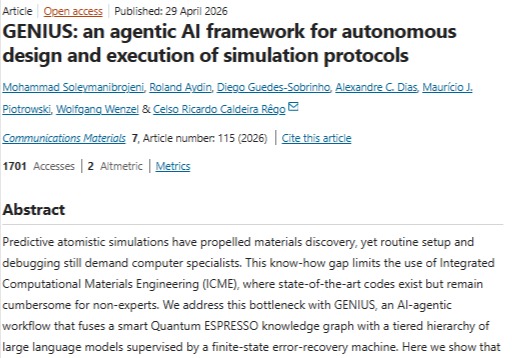 Read article
Transition-metal nanoclusters exhibit structural and electronic properties that depend on their size, often making them superior to bulk materials for heterogeneous catalysis. H...
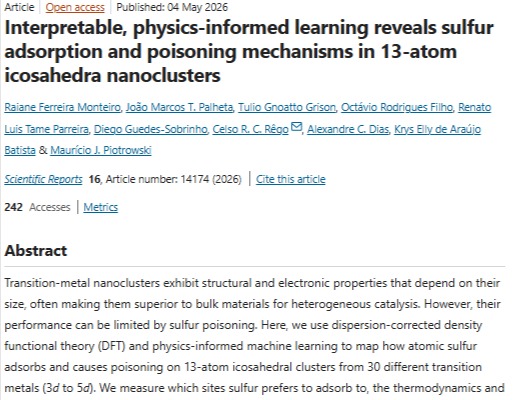 Read article
PANaIA acknowledgements the support and collaboration of CNPq (National Council for Scientific and Technological Development).


Project:
Automated Protocols for Metallic Nanoclusters
with Predictive and Generative AI